History of armchair styles
from antiquity to the Second World War
Introduction
Generalities
The armchair is one of the most studied and celebrated objects in the home. Creators have always devoted more effort and resources to it than to any other type of furniture.
Technologically, the armchair benefited early on from all innovations as they appeared; intellectually, it followed all currents of thought that marked their time; artistically, it illustrated all sensibilities that influenced the fine arts, particularly architecture.
Today, every renowned "designer" aims to produce a seat they hope will become "iconic" over time.
As "boredom arises from uniformity," whenever a style becomes predominant, young pioneers always rise against it and propose a new direction.
Often, creators who follow these pioneers lose sight of the original idea and fall into excesses or abusive simplifications that lead to the decline of the style.
This explains the proliferation of armchair styles over the centuries
General definition
An armchair is a large seat composed of a seat, a backrest, and two arms or armrests.
It is generally upholstered, sometimes caned.
It rests on a base, usually consisting of four legs, sometimes reinforced by a stretcher connecting them.
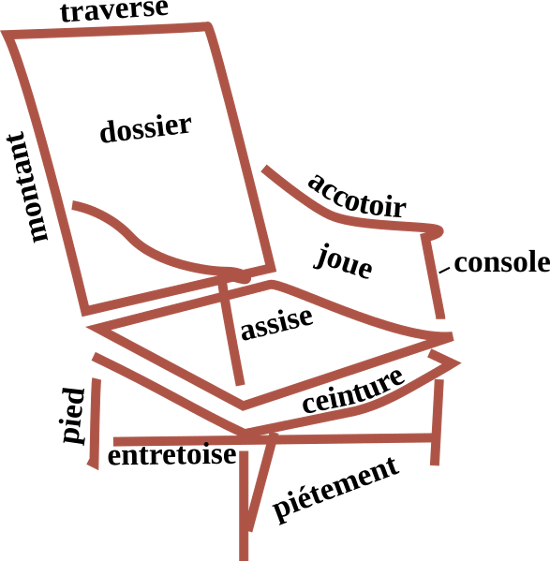
The depth of the seat is between 50 and 55 cm and forms an angle of approximately 90° with the backrest. The armrests rest on consoles. They can be openwork or padded, and include padded cuffs. The side panel is the space bounded by the armrest, the seat, and the backrest; it can be empty or solid.
The footprint of an armchair exceeds that of a chair (which has no armrests) by about one third.
Simplified nomenclature of an armchair:
History from antiquity to the Second World War
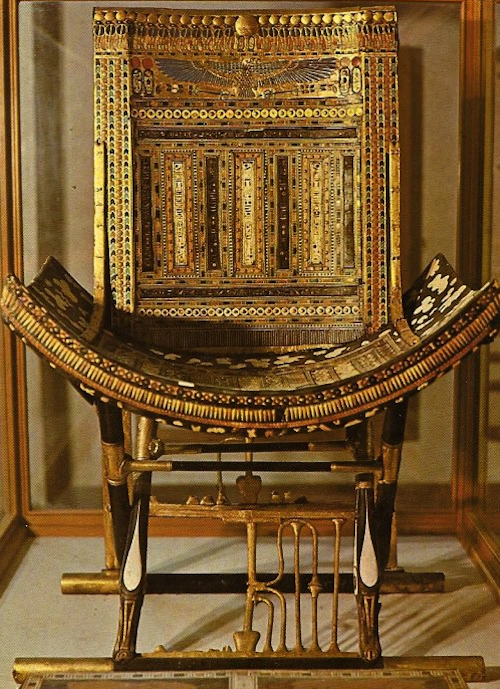
Egyptian Antiquity Armchair
Influence:
Pharaonic armchair.
Silhouette:
Wooden armchairs decorated with inlaid ivory pieces.
Backrest:
Armchairs have very high and curved backrests.
Seat:
Features a seat made of braided cords.
Fabrics:
They are covered with a cushion that overflowed and fell back.
Greek Antiquity Armchair
Backrest:
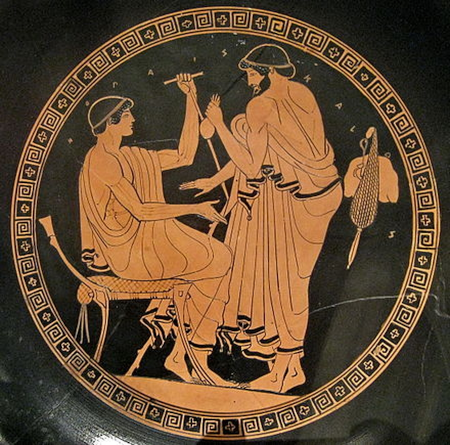
Features a curved backrest.
Seat:
Upholstered leather with plant fibers.
Legs:
Has bent and tapered legs.
Miscellaneous:
The Greek klismos is a type of chair from ancient Greece.
Roman Antiquity Armchair
Seat:
The seat consists of braided straps or leather.
Fabrics:
The Romans placed cushions on the seat.
Miscellaneous:
The Romans received guests, ate, and rested on beds.
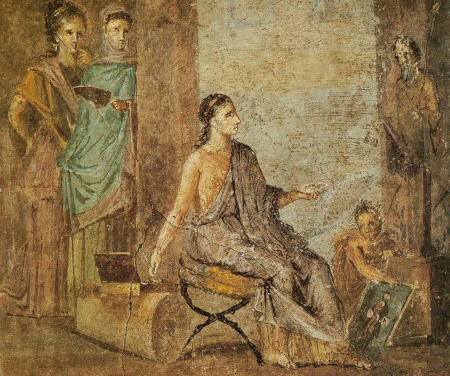
The antique curule chair is a type of folding stool formed by two crossed legs on which a piece of fabric is stretched.
High Period Armchair: 10th - 15th Century
Influence:
Roman, Gothic and Ogival
Silhouette:
The seat serving as an armchair in the Middle Ages is a Chair with a high backrest.
It may be topped with a canopy that lowers the voice of the speaker.
There are also two-seater chairs.
Backrest:
When present, the backrest is high and vertical with panels sculpted in bas-relief, shaped like stained glass windows.
Seat:
Very high, it is made of leather or fabric, and can be covered with simple pillow-shaped cushions, bolsters, or a rug called a "banker's rug".
Armrests:
Used for "armed chairs," low-back armchairs, taller than wide, with an H-shaped stretcher base.
Fabrics:
A dorsal is a piece of tapestry or fabric attached to the backrest of an armchair, replacing the backrest of benches and stools placed against the wall.
Legs:
The three-legged stool with straight legs and a triangular seat was popular at this time.
Miscellaneous:
The chair symbolizes power and authority; it is a cathedra for religious figures. It sits at the top of the hierarchy of seats of the era:
- A carreau is a cushion placed directly on the floor
- A placet is a stool with four straight baluster legs
- The basset
- The escabeau or step stool, taller than the placet
- The ployant is a stool with X-shaped legs connected by a crossbar
- The back chair
- Armchairs
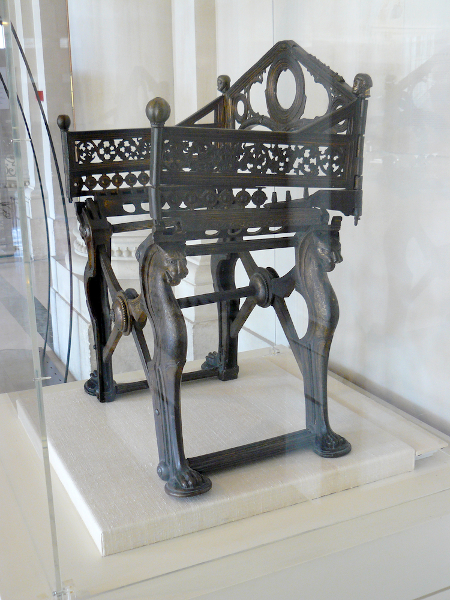
Kings and nobles often used a folding version: the faudesteuil, inherited from the curule chair, easy to transport during their travels/
Key figures:
"The good Saint Eloi", a goldsmith who helped build a throne for Clotaire II in the 7th century before becoming his treasurer and that of his son Dagobert.
In the Middle Ages, artisan trades became organized, and the "huchier" handled light and small furniture, but remained part of the carpenters' guild.
Early period favorite: Throne of Dagobert
Renaissance armchair: 1480 ~ 1600, from Charles VIII to Henry IV
Influence:
Italian Renaissance, revival of Greek and Roman arts.
Silhouette:
At the end of the 16th century, the Renaissance chair is topped with a backrest crest decorated with a frieze.
The decoration is enriched with shells and acanthus leaves.
Backrest:
The chair's backrest is topped with an entablature featuring a sculpted pediment.
It is fitted with a fixed fabric or leather panel, secured with tacks and fringes. Often, a mirror or shield-shaped motif decorates the backrest.
The most common chair has a high backrest made of joined boards.
Seat:
The seat also serves as a storage box.
Armrests:
The chair can be equipped with arms that flare forward.
Fabrics:
Sober fabrics are required.
Embossed leather studded with gold tacks begins to spread.
Miscellaneous:
The armchair features a shortened backrest and is the ancestor of the modern armchair.
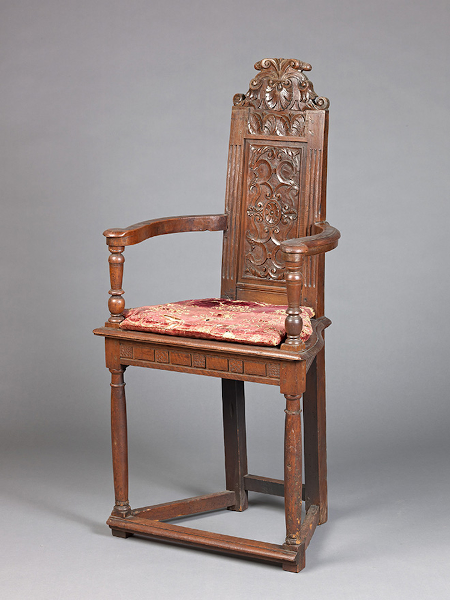
The Caquetoire - a term coined in the 19th century - was placed near the fire; at the time it was called a woman's chair. It later took the name causeuse or chaise à vertugadin. It has a fairly low, flat, trapezoidal seat and a narrow backrest.
The characteristics of this style are also present on seats in the Henri 2 or neo-Renaissance style, which spread widely during the second half of the 19th century and persisted into the 20th.
Key figures:
From the 16th century onwards, "furniture joiners" are distinguished.
The profession of cabinetmaker appeared in the 17th century to work with precious woods from the New World and Africa, including ebony.
Laurent Stabre, "ebony joiner" and maker of cabinets for the king, was granted lodging at the Louvre by royal letters patent dated December 22, 1608.
Jacques Androuet du Cerceau is known for his publications of reference collections for the joiners-huchiers of the time.
Hugues Sambin offers overflowing sculptures.
Renaissance favorite: Caquetoire
Louis XIII armchair: 1600 ~ 1660
Influence:
Flemish, Italian, or Spanish influences.
Silhouette:
Straight lines that largely fit within a cube, with a decorative raised molding profile featuring garlands and flowers.
Backrest:
The rectangular backrest, in line with the rear legs, tilts slightly backward.
Seat:
Armchair seats begin to receive thicker fixed upholstery, made of cotton and horsehair, which constitutes the stuffing. The upholsterer-stuffer also uses webbing and layers of animal hair.
It has a square shape with sharp angles, and a braid and fine fringes run along the edge of the seat.
The placet and step stool also benefit from fixed padding.
Armrests:
The armrests are generally shaped - meaning composed of a series of curves and counter-curves, convex and concave - and rest on consoles in line with the front legs.
Their ends may be sculpted with human or animal heads, such as lions or rams.
Fabrics:
The embossed leather covering, red or yellow stamped, is imported from Spain.
Covering fabrics, often embroidered, depict greenery or stripes.
Large tacks and heavy trim complete the decoration.
Legs:
They are often turned and connected by H-shaped stretchers.
The motif can be "twisted" (helical), "beaded" (succession of spheres), or "pear-shaped".
Decorations of scrolls and abundant acanthus leaves are found on the stretchers, arms, and backrests.
Miscellaneous:
The armchair is now characterized by its armrests and a wide backrest.
Visible woods are often hard turned woods like walnut, beech, or cherry.
Towards the end of the reign, sinuous furniture pieces with rounded sections, in the shape of brackets, are said to be in sheep bone style.
Key figures:
For some artisans, Henry IV provided workshops and housing on the ground floor of the Louvre gallery, which also housed foreigners, such as the famous Dutch cabinetmaker Pierre Golle, specialist in copper marquetry, and the Italians Domenico Cucci, specialist in stone and marble marquetry, and Philippe Caffieri.
Jean Macé of Blois trained in the Netherlands and created the French school of marquetry.
Louis XIII favorite
Louis XIV armchair: 1660 ~ 1715
Influence:
Classicism
Silhouette:
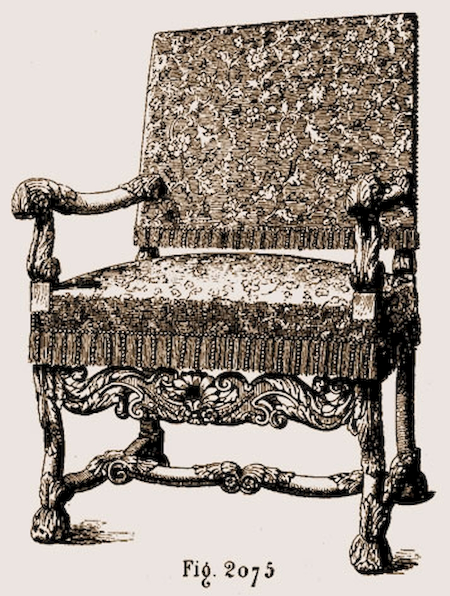
Very close to the Louis XIII style, the shapes of the Louis XIV armchair are nevertheless a bit more rounded, while remaining monumental and very symmetrical.

Backrest:
The backrest becomes more imposing, taller, and tilts a bit more backward.
Seat:
The seat widens and deepens.
Armrests:
Its armrests curve in a large sculpted arc, often in "crow's beak" shape, a form inspired by a bird's beak.
Acanthus leaf sculptures are still present. The end of the armrest extends beyond its console.
Visible woods can be gilded with gold leaf.
Fabrics:
Covering fabrics can be precious, such as silk, brocade, damask, velvet from Genoa or Utrecht, or satin, with bright colors like crimson red enhanced with gold and silver.
Embossed leather, rattan, and straw tops are also found.
Legs:
They are more varied; the baluster leg base is more frequent with X-shaped stretchers.
Miscellaneous:
The Sun King solicited artists to seek more refinement and comfort, thus revealing the rank of the seat's owner.
The confessional armchair is equipped with two padded wings and a seat fitted with a cushion. A rack can tilt its backrest.
Sofas the size of three armchairs can be found.
Key figures:
André-Charles Boulle, the King's cabinetmaker, developed tortoiseshell and copper marquetry, which revolutionized cabinetmaking and dominated the 17th century. He borrowed decorative motifs from Antiquity.
The Migeon dynasty, all named Pierre, were famous joiners and cabinetmakers.
Pierre Golle and Domenico Cucci continued their work.
The Hache dynasty distinguished itself in Grenoble.
Louis XIV favorite
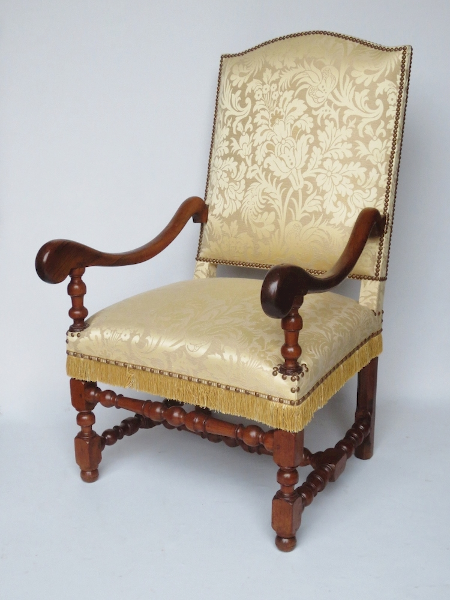
Regency Style armchair: 1700 ~ 1725
Influence:
Rocaille, which draws inspiration from the mineral world and seashells, and Chinoiserie, which was imported by the East India Company.
Silhouette:
The Louis XV armchair remains imposing, but with more finesse. Stretchers become rarer, lines are more curved, but still symmetrical. Sculpture is abundant; the shell is pierced and torn.
Backrest:
Still flat, it lowers significantly. The top rail rounds off, often in a gendarme's cap shape. The outline can be violin-shaped and have a curved crest. The top rail is sometimes visible.
Seat:
The seat apron has visible wood; ebony has disappeared.
Armrests:
The armrest attachment moves back onto the seat and the cuff becomes widespread.
Fabrics:
Fabrics are less ornate.
Legs:
Shaped, often curved, they end in a crook (Roquillard) or sometimes in a deer leg. The stretchers are in an X shape.
Miscellaneous:
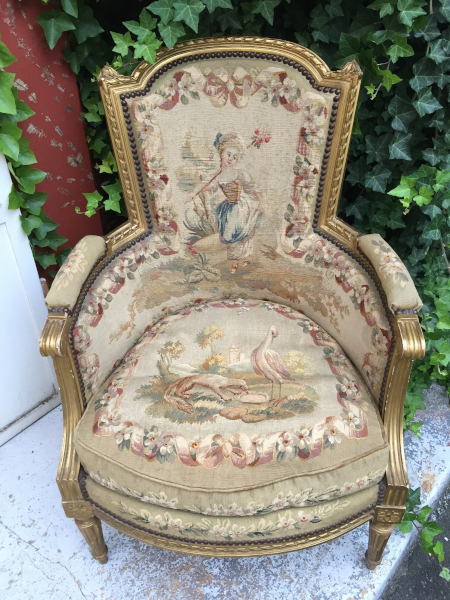
- Bergères become widespread from 1725:
A bergère is a chair with a more reclined backrest and a lower seat, whose upholstered sides extend the backrest on both sides as recessed armrests. It is fitted with a large removable goose down cushion that adds to its comfort. The name "bergère" likely comes from the recurring shepherd scenes in their tapestry decorations - "Confessional" bergères have "ears" or "orillons" that can be removed, along with other parts of the frame, to adapt the decoration to the seasons. The ears are high sides against which the confessor places his ear to hear the sins of the person confessing
- The Queen's Chair was created at the end of the Régence style and the beginning of Louis XV's reign, in homage to Marie Leszczynska. It is characterized by:
- a flat, slightly inclined and padded backrest,
- a trapezoidal seat with a curved front apron,
- an imposing weight that generally designates it to be placed against a wall
- Widespread adoption of Cabriolets with curved backrests, easily transportable. The Cabriolet armchair is a light seat named after horse-drawn carriages. It moves easily. The seat is semi-circular at the back and the arched or violin-shaped backrest at shoulder height fits the back
- Stools, sofas and chauffeuses are created. The chauffeuse, a descendant of the "Caquetoire", is a chair with a low seat and high backrest, without armrests, used for sitting near a heat source

Main names:
Charles Cressent is the rival of André-Charles Boulle and one of the main representatives of the Régence style and the early Rocaille style. He was the cabinetmaker to the Regent.
The "Pierre" Migeon dynasty continues to work.
The architect Robert de Cotte initiates "Rocaille" type furniture.
Régende favorite
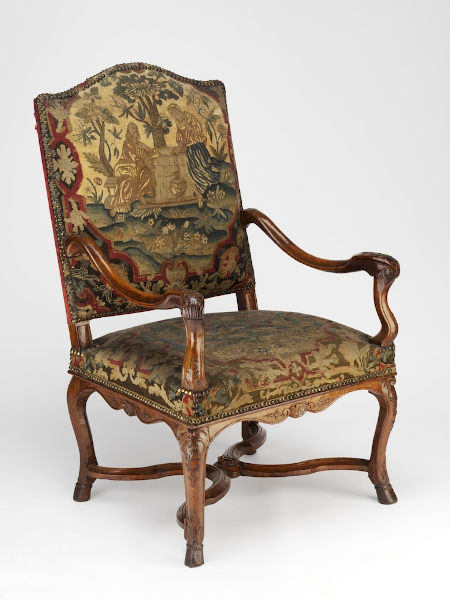
Louis XV then "Pompadour" armchair: 1723 - 1760
Influence:
Rocaille, Baroque, Rococo and Art Oriental.
Under the influence of Madame de Pompadour, towards the end of the reign, the future Louis XVI style is announced with a return to classicism, in reaction to the excesses of flower, garland and shell decorations.
Silhouette:
Advances in cabinetmaking allow for lighter shapes in armchairs, which become the "comforts of conversation" and colonize Parisian salons.
Louis XV armchairs are adorned with rocaille or rococo motifs: shells, acanthus leaves, very often asymmetrical.

Backrest:
Flat for Queen's Chairs and slightly curved for cabriolets, the outline consists only of curves.
The top rail is always visible.
The seat:
Seats widen for the very bulky pannier skirts.
The apron of the seats is generally bulging in the central part.
Armrests:
The armrest attachment remains recessed and the cuffs widen into small cushions.
Fabrics:
Upholstery fabrics borrow their motifs from fauna and flora.
Pastoral scenes or chinoiserie decorate character backrests and animal seats.
Lower-end seats are dressed in velvet or "gros de Tours" - taffeta with a coarser weave - while silk, brocade, satin, damask and brocatelle are reserved for luxury.
Legs:
The swan neck curve is mandatory. Stretchers disappear.
Miscellaneous:
A royal edict of 1751 legalizes the stamp mark.
The concave-back Cabriolet is very popular.
The Queen's Chair declines in the face of the "explosion" of bergères:
- Two-seater Bergère or Marquise
- Peeping Bergère with an armrest on the top of the backrest, allowing observation of players in salons, models straddling for men and kneeling for ladies
- Bergère with a compartment in the backrest cuff: the ponteuse contains game tokens, the fumeuse contains smoking accessories
- Gondola Bergère, with a very enveloping backrest that joins the armrests at sharp angles
- The "obligeante" bergère spreads its arms to accommodate pannier skirts; it takes the name "boudeuse" when the arms are straight and rigid
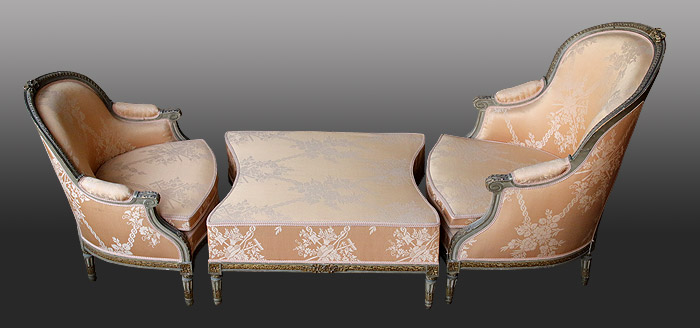
- Bergère Duchesse which is a chaise longue with a curved backrest that can be broken into two or three parts
Main names:
Jean-François Oeben, pupil of Boulle who had the famous Jean-Henri Riesener as an apprentice, famous initiator of the Louis XVI style.
Other cabinetmakers: Joseph Baumhauer, Jacques Dubois, Claude-Charles Saunier, Jean-François Leleu and Bernard Van-Riesenburgh, Pierre Migeon IV is also a cabinetmaker and merchant. The Hache dynasty continues its path in Grenoble.
Louis XV favorite: Broken Duchesse Bergère
Louis XVI or neo-classical armchair:1774 ~ 178
Influence:
Antique, following the discovery of the ruins of Herculaneum and Pompeii in 1709, and the excavations of 1738 and 1748.
Silhouette:
The silhouette of the Louis XVI armchair is much more sober as simple and symmetrical geometric shapes are favored.
Backrest:
Return to the upright panel backrest, rectangular or oval.
Motifs, often pineapples, adorn the upper corners of the backrest.
The seat:
The seat is generally straight and geometric.
Fabrics:
Fabric often striped or solid.
Lampas, a fabric with raised patterns using precious metal threads, replaces embroidery in cooler tones.
Jouy fabric is widely used.
Armrests:
Armrests are carved with bead friezes, piastres, ribbons, pineapples and laurel branches. Their consoles are arched, S-shaped or fine balusters.
Legs:
Armchair legs are most often straight, turned into tapered columns and decorated with fine straight or spiral flutes. They can also be spindle-shaped, faceted or quiver-shaped.
The junction of the leg with the apron is generally ornamented with a block often carved with an acanthus leaf, which is the emblem of Louis XVI.
The ends of the legs are in the shape of a sabot, a spinning top, a lion's paw, or a thimble finished with a bronze cube.
Miscellaneous:
The backrest of the straight-back Cabriolet, generally square or rectangular, can also be:
- medallion: rounded shape created by Louis Delanois in 1769,
- shield: the shape of an old shield with a pointed gothic bottom,
- gendarme hat style: a shape that evokes the peaked cap of the old gendarmerie, composed of three circular arcs,
- basket handle style: the shape of an arch formed by a semi-ellipse taken on its major axis, resembling the handle of a basket,
- hot air balloon style: shaped like a balloon
They can be reupholstered or painted in white or Trianon grey.
Main names:
We find Jean-Henri Riesener, Claude-Charles Saunier, and Jean-François Leleu, who had started under Louis XIV.
Added to them are Guillaume Beneman, Adam Weisweiler, and Jean-Ferdinand Schwerdfeger.
Jean-Baptiste Boulard, Jean-Baptiste Lelarge, Louis Delanois, and Jean-Baptiste-Claude Séné… contribute significantly to the field of seating.
Georges Jacob is the founder of a dynasty of cabinetmakers that excels until 1847.
Louis XVI favorite:
Directoire and Consulate armchair: 1789 ~ 1804
Influence:
Neoclassicism and the Egyptian Campaign
Revolutionary emblems invade furniture:
- spirit levels,
- joined hands,
- peaks,
- the eye inscribed in a triangle,
- the three orders of the nation: the cross, the sword, and the spade topped with the Phrygian cap, etc.
Silhouette:
With streamlined silhouettes, this style foreshadows the Empire style, but without heaviness, featuring large smooth surfaces and minimalist decoration with little bronze.
Backrest:
A large semicircular band, or inverted crook. The body of the backrest can be openwork, with a motif of an urn, palmette, lyre, or cross in the center.
They can be inverted:
- "crook" curling like a roll of paper
- "horn" flaring into a trapezoid
The seat:
The front apron of the seat is often carved.
Armrests:
Armrests become flat again and rest on consoles aligned with the legs, carved as balusters, sometimes adorned with sphinxes, the female avatar of the sphinx.
Fabrics:
Stripes are preferred, but antique and Egyptian motifs are very fashionable.
Legs:
Front leg in spindle or quiver shape, rear leg in saber shape (Etruscan style).
Miscellaneous:
The abolition of the Corporations in 1789 causes a break in furniture manufacturing.
Solid wood in cherry, mahogany, or painted beech replaces veneer and marquetry decoration, which has become too expensive.
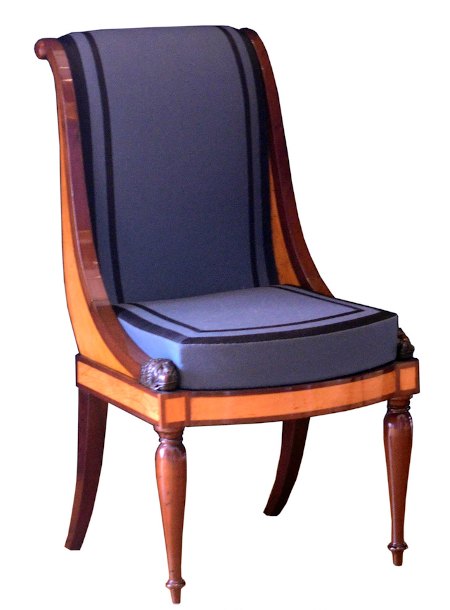
The gondola chair and the gondola armchair are novelties of the Directoire style, with a rounded and enveloping backrest whose curved side posts join the seat apron.
The Roman curule chair and the Greek klismos are brought back into fashion.

Main names:
Charles Percier and Pierre-François-Léonard Fontaine are famous ornament designers of this era.
The Jacob dynasty is present: Georges Jacob fils and his brother François Honoré continue their father's work, who never ceases to give them advice.
Jean-Baptiste Claude Séné and Adam Weisweiler continue to practice excellence.
Directoire favorite:
Empire armchair: 1804 ~ 1825
Influence:
Continuation of the previous style, more ornamental.
The Empire style takes off after the coronation of Napoleon I in 1804 and persists after his disappearance.
Silhouette:
Lines are straight with absolute symmetry on vast proportions.
More devoted to display than comfort, the Empire armchair is not intended to be mobile. Silhouettes are systematically heavier and stiffer.
Bronze is heavily used in decoration, up to overloading.
The bee, the eagle, the laurel wreath, the head of a sphinx or sphinge, and the letter "N" are the most popular decorative motifs.

Backrest:
The backrest, upright, rectangular, or square, is sometimes surmounted by a pediment; it can also be rolled. Exposed wood is very often mahogany or dark wood.
The curved backrest of the gondola armchair is also found.
The seat:
The corners of the seat are right angles. The trim is knife-edge with sharp angles, achieved with a back stitch tied very tightly on the roll and finished with a chain stitch.
Armrests:
Armrests equipped with cuffs are supported by consoles of great variety. In most cases, they continue the inner leg without marking a stop at the apron.
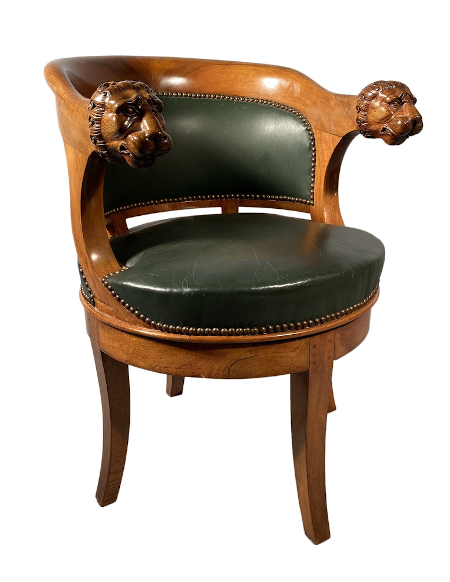
Armrests are decorated with a multitude of winged sphinxes, lions, and chimeras
Fabrics:
Lyon silks are used, boosted by the invention of the Jacquard loom in 1800, and embossed velvets. Colors are bright, such as green, yellow, red, and violet, incorporating the tones of Roman frescoes: bronze-green, purple-red, pink, golden-yellow, and midnight blue.
Legs:
Leg bases have square, cylindrical, or fluted sections in twisted bundles.
Rear legs (or even all four) are saber-shaped. Front legs can also be claw-shaped or hoof-shaped at the end of a knee joint leg. Double-bulb pears can also be found.
Miscellaneous:
The gondola armchair, created during the Directoire, is highly appreciated in interiors, as is the curule chair.
The stool is used, as under Louis XIV, to emphasize precedence. It is often X-shaped with crossed stretchers, covered with fabric.
The Etruscan chair consists of a crook backrest and saber-shaped legs.
The officer's armchair has a recessed armrest console to allow the passage of a sword or saber.
The Empire méridienne is a bed with three sides, where the headboard is higher than the footboard, connected by a regular slope. The Récamière méridienne has only two sides: a headboard and a footboard of the same height. The Dormeuse méridienne has no backrest at the foot.
Paphos are a type of sofa on a pedestal.


Main names:
Charles Percier and Pierre-François-Léonard Fontaine are found, representative of the martial taste of the Empire.
This is the great era of the Jacob cabinetmaker dynasty, especially François-Honoré-Georges Jacob-Desmalter, who launches the Etruscan style.
There are also Bernard Molitor, Pierre-Antoine Bellangé, and Pierre-Benoît Marcion.
Empire favorite: a desk chair (with a leg in the center of the apron)
Restoration armchair: 1815 - 1830
Influence:
Romanticism
This style was mainly launched by the Duchess of Berry, who preferred light woods.
Silhouette:
Seats are less voluminous, and their shapes curve and round out. The gondola shape remains very present.
Backrest:
Rectangular backrest. Very often curved in a gondola shape.
The seat:
Springs appeared only around 1825; they were then called "elastics".
Armrests:
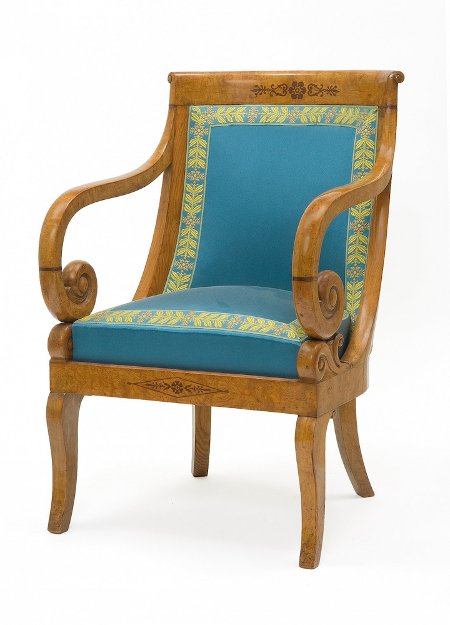
Armrests rolled into a volute, "rolled" arms, or detached in the shape of stylized dolphins or swans.
Fabrics:
Brocaded silks and satins are used, along with tapestries featuring antique motifs.
Legs
The front legs are quite heavy, often shaped as frog's legs.

Miscellaneous:
Light woods are decorated with inlays of dark wood, replacing the bronzes of the Empire style. Marquetry makes a strong comeback.
The Voltaire armchair was invented at this time. It has a high upholstered backrest with a lumbar curve that makes it very comfortable. It is worth noting that Voltaire himself never used a armchair called the "Voltaire".

Main names:
Charles Percier and Pierre-François-Léonard Fontaine are still present.
The last of the Jacob dynasty, Georges-Alphonse Jacob-Desmalter, son of François Honoré, continues their work until 1847.
Restoration favorite
Louis Philippe armchair or "Tous-les-Louis": 1830 - 1848
Influence:
All previous styles are copied without hesitation, with simplifications made necessary by mechanization and mass production: less carving and more turned wood.
This is an ephemeral style that can mix several styles on the same piece of furniture. It aims mainly for comfort and economy.
Silhouette:
Simple style, somewhat heavy, without too much ornamentation; fabrics in vibrant colors are paired with dark woods.
Seats are often fitted with casters.
Backrest:
Curved backrest.
Seat:
The seat is comfortable.
Armrests:
One-piece volute armrest, heavily curled into a crook or swan neck.

Legs:
Front legs are often shaped as frog legs or simply curved like deer legs; rear legs are splayed.
Miscellaneous:
Exposed wood is often mahogany.
The dominant form is that of the Voltaire armchair.
Appearance of the Crapaud armchair, which is shallow, stocky, wide, and very comfortable:
- The rounded and wide seat is often padded at the lumbar area with a "hump"
- The backrest is low and gondola-shaped, with the top slightly curved backward
- The mid-height legs, generally curved, give it the appearance of a frog ready to jump
- Without visible joinery, it is entirely covered and filled with fabric, tapestry, velvet, leather, or tufted cloth. It is also adorned with trimmings
Main names:
Mercier Frères.
Louis Philippe favorite
Napoleon III armchair: 1850 – 1870
Influence:
English Victorian, Ecclecticism.
The Napoleon III style is one of indiscriminate pastiches: neo-baroque, neo-gothic, neo-renaissance, neo-Rococo.
Silhouette:
Depending on the style copied. Little bronze.
Backrest:
Depending on the style copied.
Seat:
Depending on the style copied.
Armrests:
Depending on the style copied.
Fabrics:
Fabrics tend to completely cover the wood of the seats.
Tufted seats become widespread, with heavy trimmings (tassels and fringes) and ruffles. Much red and crimson are found.
Legs:
Depending on the style copied. The legs of some seats are often fitted with casters.
Miscellaneous:
Use of dark woods or black lacquer, often inlaid with copper, mother-of-pearl, or tortoiseshell, in the manner of Boule, and rich fabrics often in red and gold.
The Louis XVI-Empress armchair, created due to Empress Eugenie's admiration for Marie-Antoinette, is a pastiche of the Louis XVI style, overloaded with ornaments, with a very slightly curved backrest.
The Rothschild armchair came from England.
The Crapaud enjoys great popularity, the lambrequin armchair has a backrest in the shape of an overflowing crook, the Pompadour armchair or Mongolfière, has curved armrests and a rounded backrest.
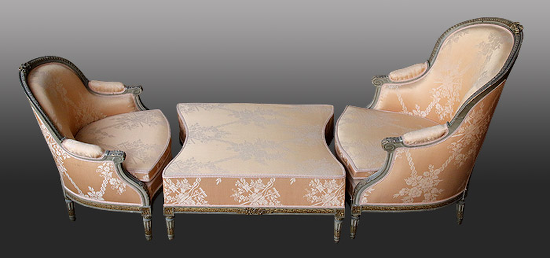
The confident (or conversation chair), two-seater, assembly of two low-back armchairs connected by an S-shaped link. If a third seat is added in a spiral, it becomes an indiscret.
The borne, circular in shape, with a central conical backrest that often serves as a support for green plants (palm, fern, etc.). Furniture placed in the center of a room, generally a living room. It offers several seats around the circumference of the circle.
The Boudeuse, double seat, where seated persons turn their backs to each other.

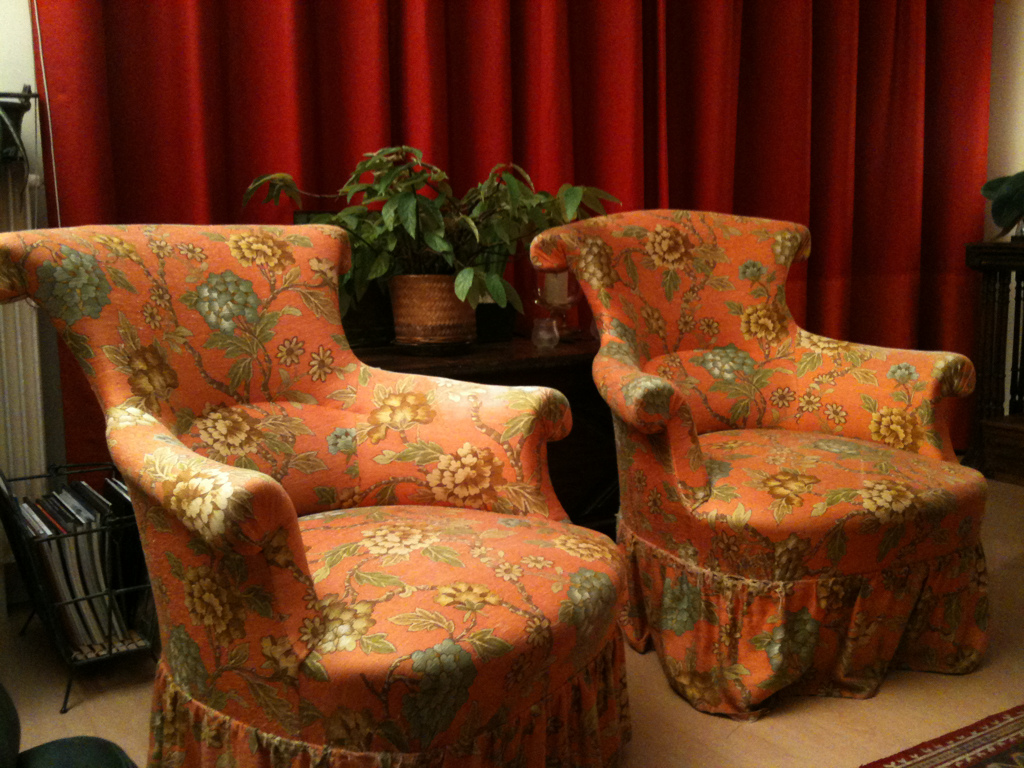


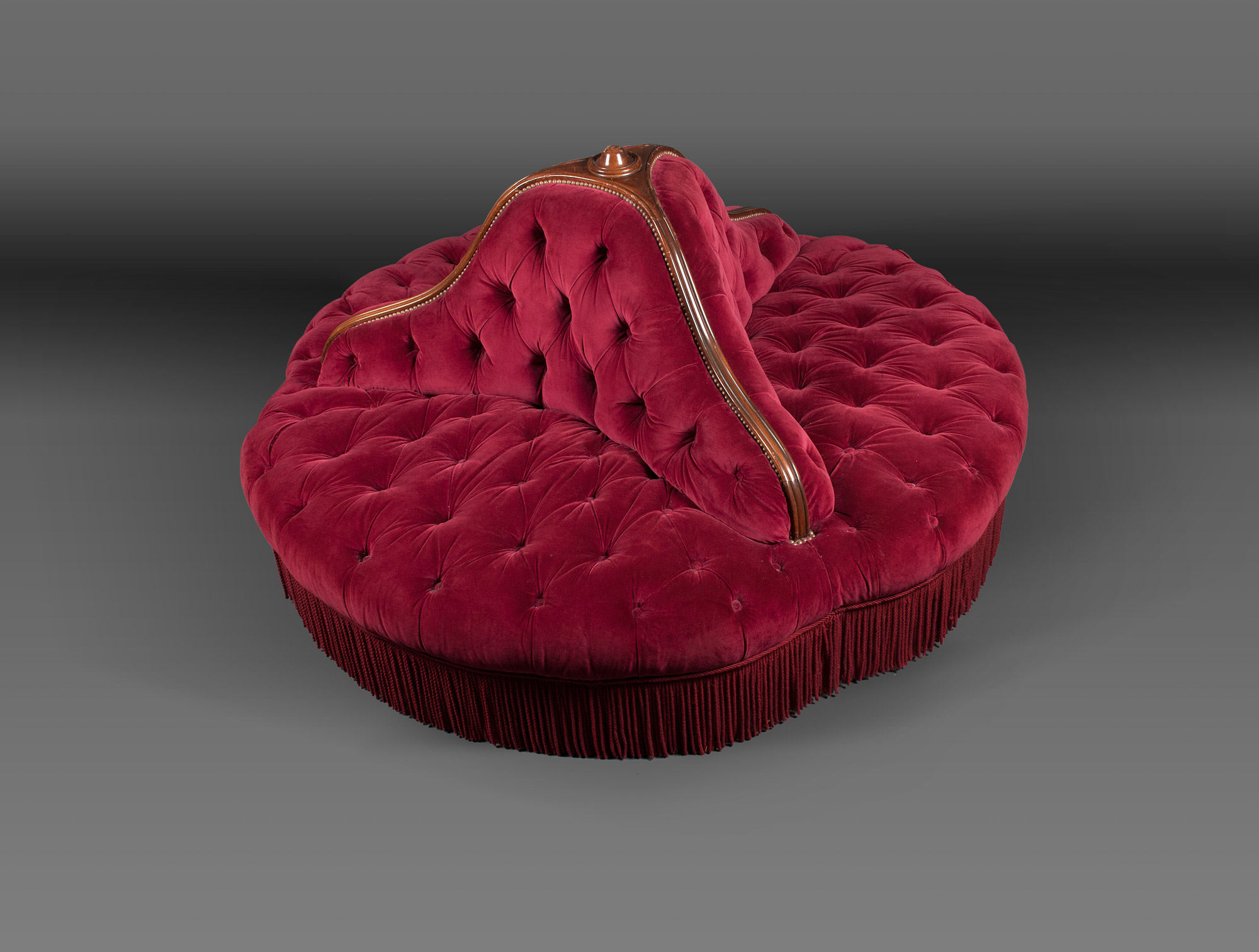

Creation of the round pouf with buttons, used as a footrest extending the armchair or as an auxiliary seat.
Only true innovations of the period: papier-mâché (or boiled cardboard, depending on the name), mostly manufactured in Pont-à-Mousson (Meurthe-et-Moselle), and some pieces in bamboo or rattan, intended for the brand new winter gardens.
The fashion for black or blackened wood furniture develops from 1840, sometimes enhanced with gilding, mother-of-pearl, or brass.

Main names:
The houses of Alexandre Georges Fourdinois, Beurdeley dynasty, Michel-Victor Cruchet, Henri-Léonard Wassmus.
Henry Dasson, Charles-Guillaume Diehl , Guillaume and Jean-Michel Grohé.
The Jeanselme family who buys the Jacob house in 1847, Krieger family, Mercier brothers, Auguste-Hippolyte Sauvrezy, Paul Sormani, Jean-Pierre Tahan, Joseph-Emmanuel Zwiener.
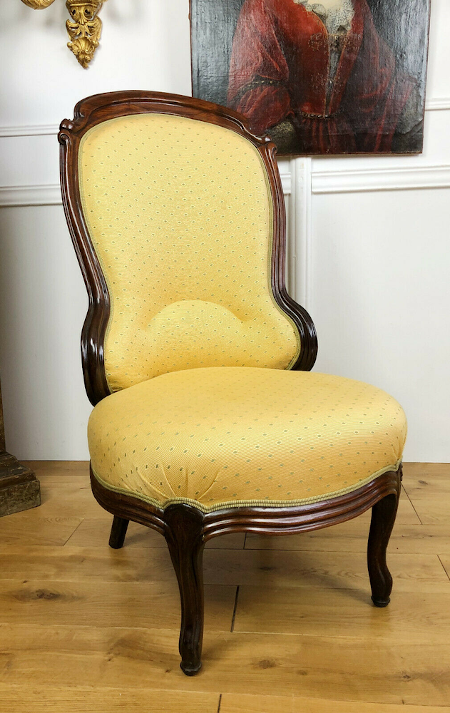
Napoleon III favorite: Pair of Chauffeuses

Henry 2 Style armchair of the 19th century: 1840 ~ 1920 or neo-Renaissance
Influence:
Ecclecticism.
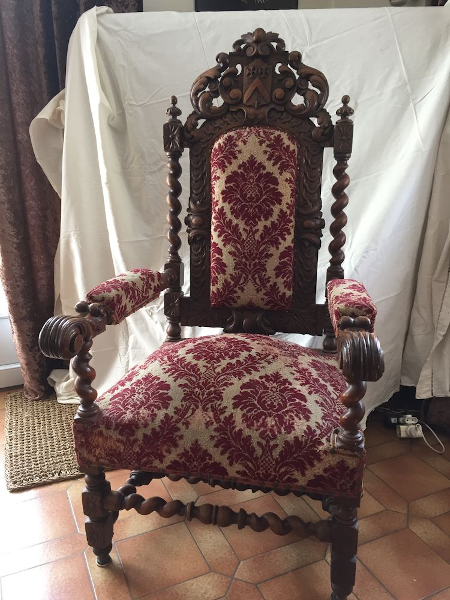
Inspired by the forms of furniture and decoration from the second half of the 16th century, the Henry 2 style or neo-Renaissance style develops in France from 1840. It reaches its peak under the Second Empire before being declined in the manufacture of industrial furniture.
Silhouette:
Furniture and decoration reproduce the stereotyped forms of the French Renaissance: architectural decor, mascarons, tops supported by ringed columns, grotesques, acanthus leaves, large overhanging cornices, turned balusters and figurative sculptures in bas-relief. This style also integrates the forms of the Louis XIII style: twisted columns, diamond point motifs and fringes on upholstered furniture. Henry II sculpture abounds with soldier-like figures and imaginary animals.
Miscellaneous:
Coordinated sets are generally offered for bedrooms (bed, headboard and wardrobe) and dining rooms: the extension table, four or six chairs upholstered in embossed leather or cane, a two-body glazed buffet and a sideboard.
Having become a conventional style over time, the term Henry 2 has taken on a often pejorative connotation but its production will last until the eve of the Second World War.
Mechanization makes this style more rectilinear and coarser than the original style.
Main names:
Meubles Camus, in Clermont-Ferrand.
Henry 2 favorite
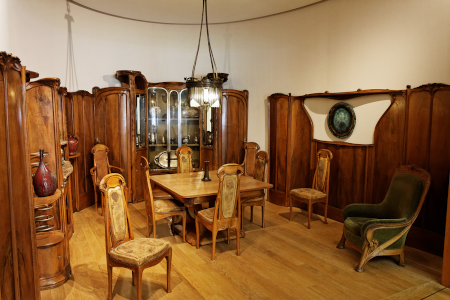
Art Nouveau or Modern-Style armchair: 1875 ~1925
Influence:
The Arts and Crafts movement, developed in England from 1880 to 1910, highlights nature themes and floral ornamentation.
It also shows traces of Gothic, Rococo, and Baroque styles. This style sits at the crossroads of several artistic movements of the time: Style Nouille, Naturalism, Modernism, Exoticism, Symbolism.
It also restores unity in interior design.
It spreads across Europe: Tiffany, Jugendstil, Liberty, Modernismo...
Craftsmanship is brought to the forefront
Silhouette:
Seats adopt the sinuous shapes of vines or other plant stems.
Often openwork and upholstered, these seats feature fluid and slender lines.
Backrest:
Backrests are high with asymmetrical shapes.
Armrests:
Very sinuous.
Fabrics:
Embroidery, natural dyes, and traditional looms are revived.
Nature is the ultimate source of inspiration, and curves and organic shapes are celebrated.
Legs:
Hector Guimard often finishes legs in an animal-spatula triangle shape.
Miscellaneous
"Art Nouveau" is the name of a shop opened in Paris on rue de Provence in 1895 by Siegfried (sometimes named Samuel) Bing.
It also restores unity in interior design.
Key names:
This style has always remained very artisanal.
A Parisian school around Bing and a Nancy school around Émile Gallé and Louis-Jean-Sylvestre Majorelle.
Notable names include Eugène Gaillard, Michael Thonet, a German industrialist who created a solid bentwood armchair whose chair number 14 or "bistro chair" achieved great success with 50 million copies sold between 1859 and 1914.
Josef Hoffmann created the Kubus armchair and "antique" dining chairs in the early 1900s.


Art Nouveau favorite: Dining room of the Hôtel Guimard (1910)
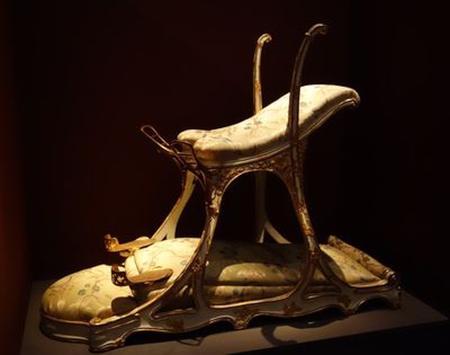
Belle Époque favorite: Seat of voluptuousness
Art Deco armchair: 1920 ~ 1945
Influence:
Cubism, Fauvism.
The term Art Deco was coined in the 60s in reference to the International Exhibition of Modern Decorative and Industrial Arts held in Paris in 1925.
Typically French, this movement peaked in the decoration of the ocean liner "Le Normandie." It turns its back on the excesses of the Art Nouveau style, focusing on comfort, simplicity, but also luxury in armchairs.
Silhouette:
Highly geometric shapes, broken lines, and simple volumes. With bright, contrasting colors on chevron, fan, zig-zag, moon section, radiant sun, or fruit basket shapes.
Sculpture disappears from furniture, replaced by veneers of precious woods, inlay, and marquetry.
Miscellaneous:
Seats are often inspired by the Directoire or Restoration periods.
Wood is rarely visible and often hidden under leather or textile coverings.
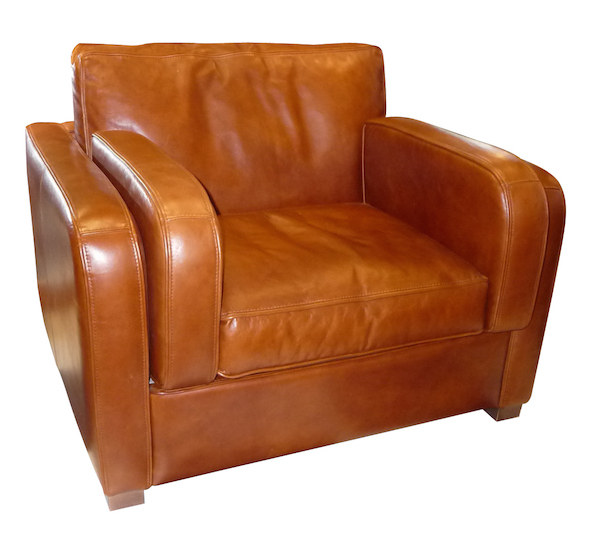
- The club armchair, half-French, half-English (Chesterfield in buttoned leather).
Deep silhouette with a generous, rounded shape. Comfortable seat covered in soft, durable basane leather - The Cosy-Corner, corner divan built into a shelved wood paneling
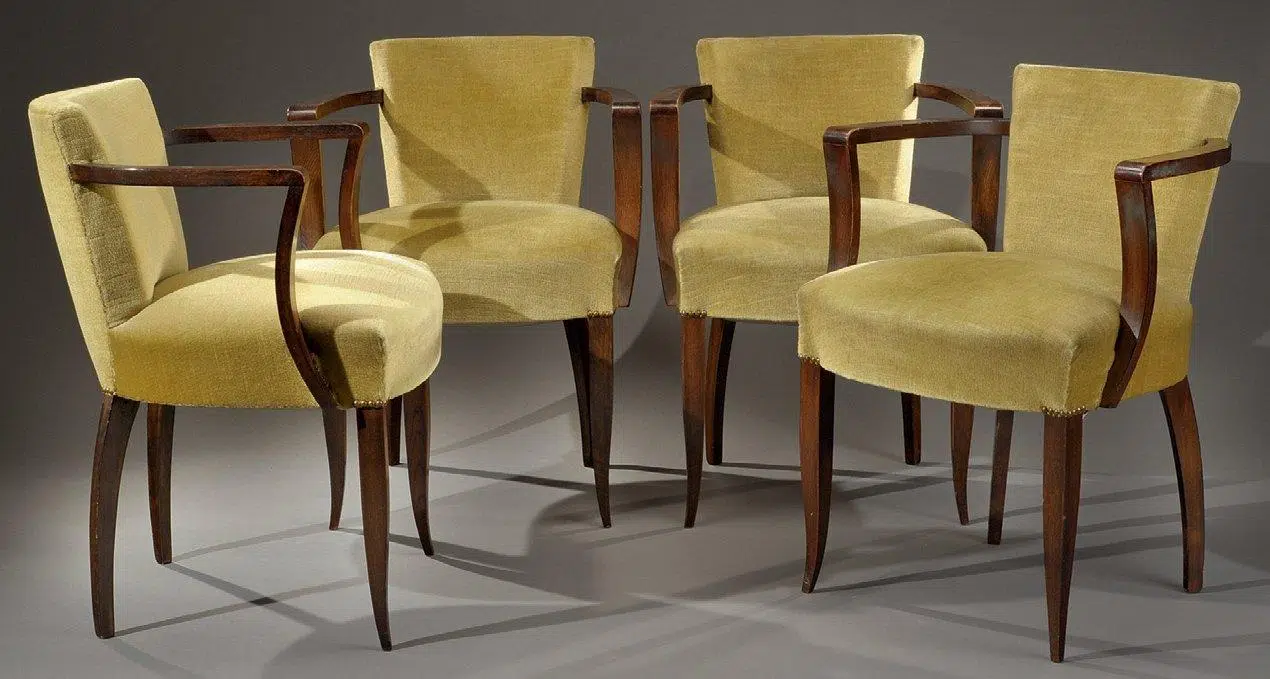
- The Bridge armchair (1930)
- It is ideal for playing cards, particularly bridge, which gives it its name
- Low backrest, straight or very slightly inclined
- Openwork armrests of low height, allowing one to rest elbows or forearms. Soft, spring-upholstered seat


Key names:
Jacques-Émile Ruhlmann, nicknamed the "Riesener of Art Deco".
Jean Dunand, sculptor, cabinetmaker, and lacquerer; Eugène Printz, user of the palm tree motif.
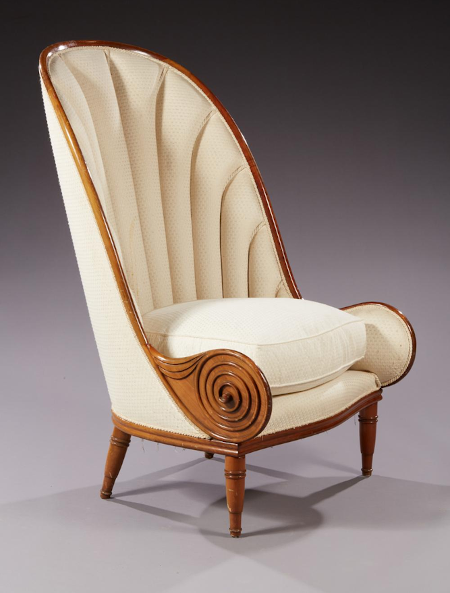
Paul Iribe and his Nautile armchair; Louis Süe, who designed armchairs with André Mare.
Maurice Dufrêne, co-founder in 1902 of the Société des Artistes Décorateurs.
Pierre Chareau, with the typical example of his Circa armchair.
Jean-Michel Franck, with his minimalist club armchair.
Paul Follot, with his Art Deco bergères.
Paul Dupré-Lafon, with his "Elephant" armchair.
Jules Leleu, who also made a Circa armchair.


Art Deco favorite: copy of Paul Iribe's "Nautile"
After 1945...
Already in the early 20th century, production became individualized. Artisans increasingly considered themselves artists, or groups of artists, trying to impose their styles or the style of their school or movement.
Later, they would be called designers.
To help navigate the jungle of productions in the 20th and 21st centuries, we suggest consulting two documents on the site:
- A "Passionate Inventory of the History of Armchairs in the 20th and 21st Centuries"
- A table "Designers of the 20th and 21st Centuries", indexable by:
- the name of the armchair
- the date of creation
- the name of the designer
- the name of the movement it belongs to