Upholstery Fabric
Choosing the right fabric to cover an armchair
If your audience gasps in admiration at the first presentation of your work, these exclamations will owe little to your meticulous and patient restoration, webbing, spring lashing, horsehair stuffing and other stitching... if they exist, they will be provoked mainly by the FABRIC!
They will immediately see how it integrates into the room and matches the style of the seat. They will judge the color immediately, then look at its patterns.
When they approach, they will touch it to appreciate the texture with their hand, then with their body when they sit down.
Later, they will appreciate its durability and ease of maintenance.
So there are many reasons to carefully consider what is often the most expensive item in the refurbishment.
To help you in this reflection, we will take a camera and zoom in on the object in question.
The goal is not to give you ready-made solutions, but to help you ask the right questions so that you are not disappointed with the final result.
Wide shot: armchair in the room
A fabric will not have the same effect in a space with a busy decor or in a sparse environment. The style of the armchair you are covering must be adapted to the density of the other furniture.
The other colors present in your home will interfere. Think about rugs, floors, wall paints and wallpapers.
You can decide to play with contrasts or complementary colors. You must decide whether you want an armchair that blends harmoniously into the decor: a combination of shades of the same color yields good results; or whether you want it to stand out from the decor.
This is where you need to choose the color.
When you go shopping, make a color chart of the other tones present in the room and also ask for samples about one meter long. You will then place them on your seat and leave them there for about two weeks to judge the effect produced.
It is also at this level that you need to think about lighting and exposure:
Light is absorbed by dark colors and reflected by light colors.
The same shade undergoes a complete metamorphosis under natural or artificial lighting; it will not have the same appearance under a floor lamp or daylight, under direct, diffused lighting, or in semi-darkness.
- On velvet, light accentuates curves and shadows, creating a sense of luxury.
- Fabrics with thick weaving, such as wool, absorb light, while silk and rubberized materials reflect it.
- Fabrics with a more natural appearance, such as silk, reflect light.
My mother always asked to leave the store to look at the fabric in daylight, regardless of my embarrassment at being displayed as a model in Sunday best in front of passersby.
But she did the same for the purchase of all sorts of other more or less bulky products.
Medium shot: closer view of the armchair
As a general rule, the style of the seat, that is, its age, shape and personality, imposes certain specificities.
A very modern fabric risks clashing with the refinement and delicacy of an antique seat. If the woodwork is original, a solid fabric, such as linen, is enough to highlight the details.
If the seat is plain, a woven fabric or one decorated with patterns will be suitable!
At this level of detail, you need to consider the patterns.
They can completely transform the face of an armchair. Their size must be in proportion to the dimensions of the furniture.
They should not be cut off or create a cumulative effect; they should echo the shape of the seat: sinuous drawings for wide scrolled armrests; geometric patterns for seats with clean lines.
A fabric with small patterns will of course have less visual impact than one decorated with large patterns. The use of fabrics with large-scale designs remains a bold choice.
A very contemporary fabric can also give new life to an old seat.
Trimmings (ribbons or piping...) can provide a nice finishing touch.
At this distance from the armchair, you can ask yourself the question of finishing with decorative nails or a braid to hide the upholstery tacks, which you can buy ready to use:
- Piping: single or double
- Lézarde: narrow braid
- Cord
- Giselle: small scalloped braid whose chain curves like the tail of a lizard
- Ganse: flat braided braid
Close-up: touching the armchair
You should then take into account the texture.
A patterned fabric is even more attractive when it presents variations in texture
Natural fibers such as wool, cotton or silk are conventional fabrics to which the most diverse materials, generally synthetic, have been added.
Some fabrics combine several materials, such as velvet and linen, while others include metallic fibers.

Corduroy fabric sold by the meter
- Composition of 85 % polyester, 12 % polyamide and 3 % elastane
- Weight of 330 g/m², width of 150 cm
- Suitable for sofas, armchairs and chairs
Leather is available in a wide range of colors, textures and thicknesses, generally sold as whole hides. Prefer aniline-treated hides.
Leather with rougher tanning will gain in durability but lose in softness.
Suede or daim is a leather that is always in vogue. It is a material with an unmatchable touch, both rich and soft.
Suedine is a fabric that closely imitates suede, having its appearance and feel.
Solid wool is well suited to refined furniture or contemporary seats. It can be combined with many covering materials: leather, suede and synthetic fur.
Note that wool is not suitable for daily use.
Linen gives a contemporary flavor to any seat.
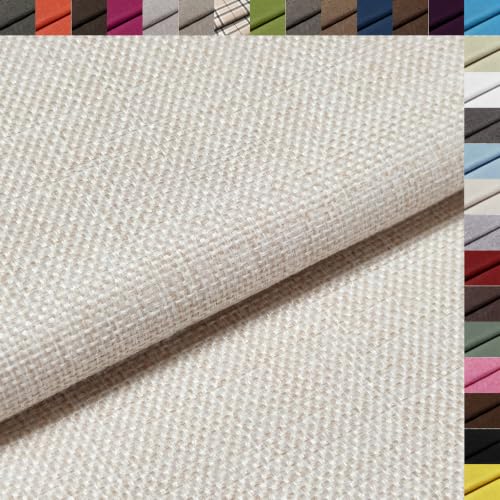
Upholstery linen fabric by the meter
- Linen look in polyester, width of 148 cm
- Abrasion resistant, up to 100,000 rub cycles
- Suitable for sofas, armchairs, chairs and benches
Synthetic fur can also be used.
This is also where you should consider durability and ease of maintenance.
You must mainly consider the use of the seat: decorative or utilitarian.
Most upholstery fabrics have a wear resistance coefficient.
There are two fairly common tests, the Martindale test and the Wyzenbeek test:
- For decorative furniture only: 12000 Wyzenbeek or 9000 Martindale
- For furniture with fairly low usage: 15000 Wyzenbeek or from 10000 to 15000 Martindale
- For furniture with normal or heavy usage: 30000 Wyzenbeek or 20000 Martindale
Do not hesitate to ask sellers about the meaning of these codes.
As for fire resistance, according to French standard EN 13-501-1:
- M0: non-combustible
- M1: combustible // non-flammable
- M2: combustible // difficult to ignite
- M3: combustible // moderately flammable
- M4: combustible // easily flammable
- NC: unclassified // unclassified
Also consider ease of maintenance, which you should check before buying.