Reupholstering a Voltaire armchair
The specifics of renovating a Voltaire armchair
Overview of the Voltaire armchair
Characteristics of the Voltaire armchair

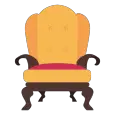
A Voltaire armchair has a very recognizable appearance; here are its main characteristics:
History of the Voltaire armchair
Voltaire died in 1778 and the "Voltaire armchair" appeared in the 19th century under the reign of Louis-Philippe from 1830 to 1848. The famous philosopher therefore never sat in this eponymous armchair.

However, portraits of the time show him relaxing, at the end of his life, languishing in a high medallion armchair with an exposed natural wood backrest.
This is presumably why, many years later, the name "Voltaire" was given to the armchair discussed here.
At the end of the 19th century, the Voltaire armchair was mainly intended for patients and elderly people; some were even made convertible into a birthing table!
Originally, "Voltaires" featured large floral decorations on a dark background. The same theme, on a black background, would be taken up by the Napoleon III style.
How to reupholster a Voltaire armchair? Tutorial
We will assume that the padding of the seat of the armchair has already been completed following the procedure below:
- Full stripping
- Restoration
- Webbing
- Springs on webbing
- Spring lashing
- Hessian seat
- Lacing and vegetable horsehair installation
- Wrapping and marking
- Tucking down & foundation stitches
- Seat tacking
- Lacing and animal horsehair installation
- White lining
- Cotton batting installation
- Fabric installation
We can now present the specific procedure for padding the backrest of a Voltaire armchair, which includes the following steps:
- Webbing
- Hessian
- Horsehair, calico and foundation tacks
- Upholstery tacks and stitching, with a line of blind stitches
- Animal hair and white cloth
- Cotton wadding and finishing fabric
- Cuffs

Webbing
Given the considerable height of the backrest of a Voltaire armchair, it is advisable to reinforce it using webbing fixed to the front rabbet.

Jute Webbing
Roll of Natural Jute Canvas Ribbon
Width 70mm - Yellow Stripes - Roll of 25 meters

Hessian
Stretch the hessian tightly over the front rabbet, taking care to align its straight grain vertically. Stitch vertical laces to hold the horsehair in place.

Heavy jute canvas
100% jute canvas of 380 g/m² for the renovation of armchairs and chairs
Width 190 cm, woven in France and untreated

Fundamentals
After the wrapping held by temporary upholstery tacks, stitch foundation tacks that firmly hold the top of the padding on the hessian. Use the same tack arrangement as on the seat, stopping them at the level of the armchair arms, to create a small bulge for the lumbar curve.

Upholstery tacks & Blind stitches
After placing the tacks, you can make the same stitching as on the seat, while working a line of lost stitches along the innermost edge.
Finishing
It is then enough to place vertical ties to hold the animal hair, and to add the white cloth and the covering fabric. Then close the back with another strong canvas and a layer of wadding on the rear rabbet:


Restoring the armrests of a Voltaire chair
Chairs with exposed wood have independent armrests (the term armrest is reserved for the upper part of the prie-dieu on which the elbows rest).
They are fitted with cuffs that may take various shapes: kidney-shaped, parallel cylinder… They may or may not be stitched.

Place strong canvas on the flat of the cuff with a fold of about 2 cm, and fix it with tacks at mid-rabbet.

Stitch a line of 2 to 3 ties of 1 cm height in the center of the cuff.

Slide vegetable hair under the ties.

Make the hair roll by placing an underlining cloth.

If you want to firm up the cuff, you can perform a stitching:
- stitch the small cord flush with the tacks to come out on top of the cuff, vertically above the entry point
- clear the small cord and the twine to re-stitch on the same line at 1 cm, vertically below on the other side of the cuff
- come out flush with the tacks to re-stitch vertically upward, 1 cm further away.

All that remains is to finish in the classic way with:
- animal hair
- white cloth
- wadding and covering fabric